De or het? The rules that actually help
About two thirds of Dutch nouns take de, but het is common too. These patterns cover a large share of nouns; for the rest, there's one habit that works.
Coming soon to Google Play
Most language apps wait for you to open them. Language Unlock doesn't wait: every time you unlock your phone, one Dutch word at your level is already there. Tap the meaning, and two seconds later you're back to what you were doing.
Android first, iPhone later
It's rarely motivation. It's the effort it takes to start, every single day.
“I forget to open the app.”
You don't have to remember anything. You already unlock your phone 50 to 100 times a day; a few of those unlocks bring a word. No reminders, no decision to start.
“I don't have time for a lesson.”
A card takes about two seconds. Waiting for the tram, the kettle, a meeting: twenty of those moments make a day's practice without ever sitting down to study.
“Apps start too easy, and the words fade anyway.”
A 12-word test finds your level, so you skip what you know. After that, every word returns just before you'd forget it, until it's yours.
You set it up once. After that, there's nothing to do but unlock your phone.
The test adapts to every answer: harder when you know a word, easier when you don't. “I don't know” is always an option.
The app works out your level (A1 to B2) and how many words you already know, and starts right there.
10, 20, 30 or 50 words a day. With 20, that's about 600 new words in three months.
That's it. From now on the words come to you.
On the tram, you unlock to check the time.
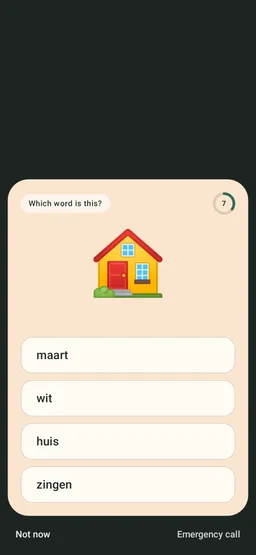
het huis → house ✓
Lunch break, you open your messages.
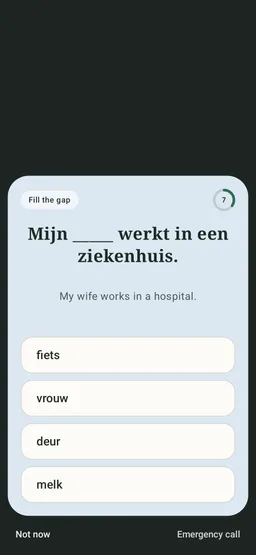
Mijn ___ werkt in een ziekenhuis. → vrouw (wife) ✓
A word you missed this morning comes back.
de afspraak → appointment ✓
Quiet hours: the cards rest until morning.
20 words today, without studying
This is what you'd see after an unlock. Tap the meaning.
de
fiets
Goed zo! That's it.Almost. It means bicycle.
het
brood
Goed zo! That's it.Almost. It means bread.
de
hond
Goed zo! That's it.Almost. It means dog.
That's three words in a few seconds. Now imagine that, a little at a time, all day.
| Study apps | Language Unlock |
|---|---|
| You have to open them | The word comes to you at unlock |
| 10–15 minute lessons | Two-second cards, all day |
| Start at lesson one | Starts at your level |
| Reminders and streak guilt | No reminders, a free rest day |
| Account, ads, internet | No account, no ads, offline |
A level counts when you know its words: 1,800+ words from A1 to B2, grouped by the themes of NT2 courses (home, the GP, work, the municipality).
Missed words come back within minutes, known words wait days or weeks. You never decide what to review.
Once a word is familiar, it comes back in a real sentence with a gap to fill. More gaps as your level grows.
Tap the speaker to hear it. Every noun shows its article, so you learn het huis, not just huis.
'Not now' and 'Emergency call' are always there, a wrong answer still opens your phone, and you choose how often cards appear.
The app has no internet permission at all. Your progress stays on your phone; you can back it up to a file.
For people who live in the Netherlands or are moving there. 1,800+ words and 200+ sentences from A1 to B2, with meanings in English or Turkish. Useful next to an inburgering or NT2 course.
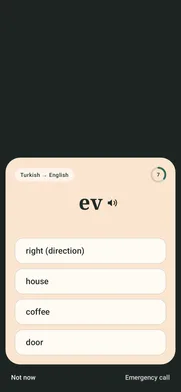
For English speakers learning Turkish: for family, friends, a partner or the next holiday. 300+ everyday words from A1 to B2, with sentences.
To learn, no: the cards come at unlock. You open the app only if you want to: to see your progress, browse your words or change settings.
When you install it, you answer 12 words. The test adjusts after every answer and places you between A1 and B2. As you learn, your level moves up with the words you actually know.
By default you get at most one card every 10 minutes. You can change that, set quiet hours, pause for an hour or a day, or tap 'Not now'. There are no reminder notifications.
No. 'Not now' and 'Emergency call' are always on the card, and a wrong answer opens your phone too.
We're preparing the Google Play test now; Android first, iPhone later. It's free, with no ads and no account, and we will never put ads on the unlock screen.
No. It builds your vocabulary, the part most learners forget between lessons. Speaking, writing and grammar still need a class, a teacher or a conversation partner.
Nothing leaves your phone. The app has no internet permission, so it can't send anything anywhere.
About two thirds of Dutch nouns take de, but het is common too. These patterns cover a large share of nouns; for the rest, there's one habit that works.
Roughly 1,000–2,000 words for A2, about 3,000 for B1 and around 5,000 for B2. What the numbers mean for inburgering and the NT2 exams, and how to get there.
Turkish has no genders, no articles and spelling you can trust. The real challenges are word endings and word order. Here's how to start.